What is EBITDA? Meaning, formula, margin and examples
Prefer to watch? The 4-minute video covers the same example.
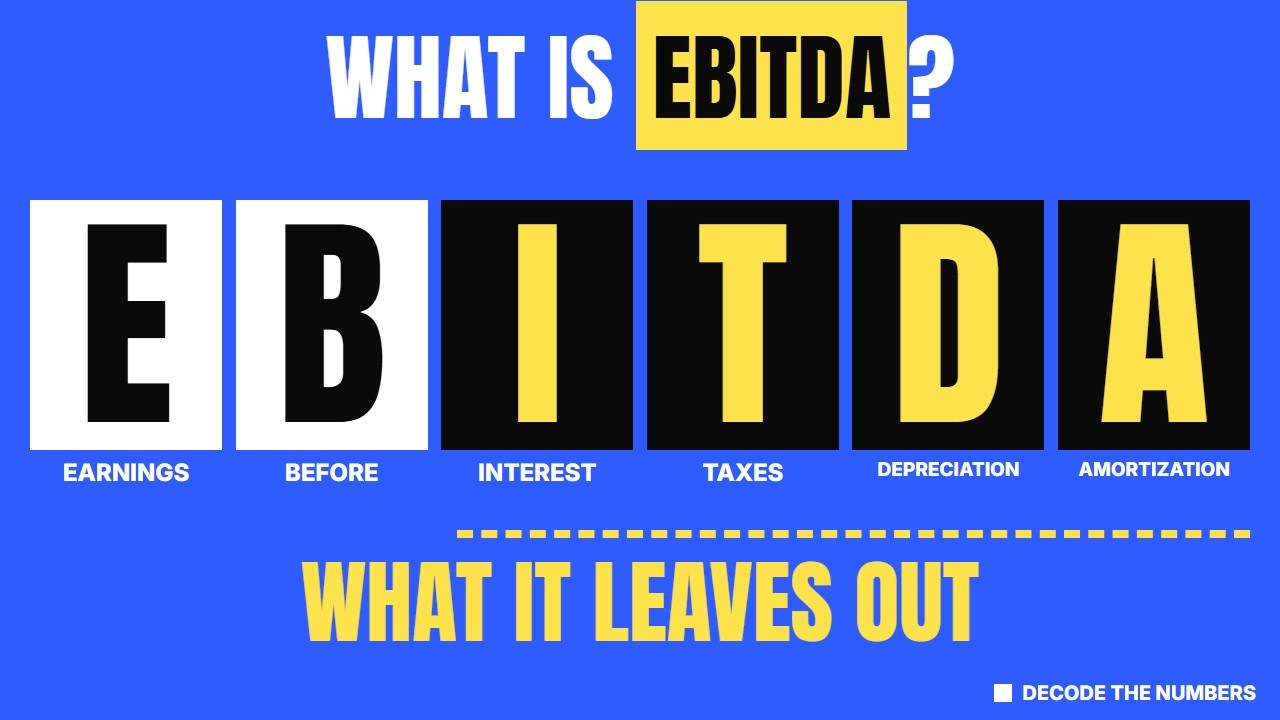
EBITDA stands for earnings before interest, taxes, depreciation and amortization. It measures how much a company earns from its core operations before the cost of its debt, its taxes and the wear and tear on its assets. Investors use it to compare and value companies, and lenders use it to decide how much a company can borrow. It is pronounced ee-bit-dah.
What does EBITDA mean?
EBITDA starts with earnings and then removes four costs that have little to do with how well the business runs from day to day.
- Interest is what the company pays on its loans. It depends on how the company is financed. Two identical shops can pay very different interest if one borrowed and the other did not.
- Taxes depend on where the company is based and on its tax position, not on how well it operates.
- Depreciation spreads the cost of physical assets, such as machines, vehicles and buildings, over the years they are used.
- Amortization does the same for intangible assets, such as software, patents and customer lists bought in an acquisition.
What remains is roughly sales minus the everyday costs of running the business: goods, staff, rent, marketing and similar expenses. That is why EBITDA is often described as a measure of operating performance.
EBITDA formula: how to calculate EBITDA
There are two common ways to calculate EBITDA. Both give the same number.
To calculate EBITDA from a company's annual report:
- Find net income at the bottom of the income statement.
- Add back interest expense and income tax expense. Both are usually listed on the income statement.
- Add back depreciation and amortization. Many companies do not show these on a separate line of the income statement, but you will find them near the top of the cash flow statement, in the section that starts from net income.
EBITDA example
Take two coffee shops that look identical. Each sells $500,000 of coffee in a year. Coffee, milk and cups cost $150,000, and staff and rent cost $250,000. Both earn $100,000 from running the shop, so both have an EBITDA of $100,000. The table shows what each shop's owners actually keep.
The differences are below the EBITDA line. Shop A paid $100,000 for equipment that lasts five years, so its depreciation is $20,000 a year. It paid with the owners' savings, so it has no interest. Shop B spent $300,000 on a designer build-out, which gives $60,000 of depreciation a year, and it paid with a $500,000 bank loan at 10%, which costs $50,000 a year in interest.
| One year | Shop A | Shop B |
|---|---|---|
| Sales | $500,000 | $500,000 |
| Coffee, milk and cups | –$150,000 | –$150,000 |
| Staff and rent | –$250,000 | –$250,000 |
| EBITDA | $100,000 | $100,000 |
| Depreciation and amortization | –$20,000 | –$60,000 |
| EBIT (operating profit) | $80,000 | $40,000 |
| Interest | $0 | –$50,000 |
| Tax (20%) | –$16,000 | $0 |
| Net income | $64,000 | –$10,000 |
Same EBITDA, but Shop A makes $64,000 for its owners and Shop B loses $10,000. Read the table from the bottom up and you can check the formula: adding tax, interest and depreciation back to each shop's net income brings both shops back to the same $100,000 of EBITDA.
The shops and their numbers are invented and simplified for teaching.
What is a good EBITDA margin?
The EBITDA margin is EBITDA as a share of sales. It makes companies of different sizes comparable.
The coffee shops have a 20% EBITDA margin:
Whether that is good depends on the industry. A grocery chain and a software company work with completely different costs, so their margins are not comparable. These are the average EBITDA margins for US companies by industry:
| Industry (US) | EBITDA margin | Net margin |
|---|---|---|
| Retail (Grocery and Food) | 5.4% | 1.3% |
| Auto & Truck | 7.5% | 1.3% |
| Retail (General) | 10.1% | 5.6% |
| Air Transport | 10.3% | 2.5% |
| Trucking | 15.6% | 3.8% |
| Business & Consumer Services | 15.6% | 7.0% |
| Restaurant/Dining | 19.5% | 9.4% |
| Hotel/Gaming | 24.5% | 10.4% |
| Cable TV | 32.4% | 7.1% |
| Telecom. Services | 34.7% | 14.2% |
| Utility (General) | 34.9% | 14.2% |
| Software (System & Application) | 35.9% | 25.5% |
| Semiconductor | 36.8% | 30.4% |
| All non-financial companies | 17.4% | 8.6% |
Source: Aswath Damodaran, NYU Stern, margins by sector (US), January 2026.
The gap between the two columns shows how much depreciation and debt cost each industry. Telecom companies keep 34.7% of sales as EBITDA but only 14.2% as net profit, because their networks cost a lot in depreciation and they carry a lot of debt. Software companies lose much less on the way down. That gap is exactly what EBITDA hides.
More: EBITDA margin formula, calculator and margins for every US industry.
EBITDA vs. EBIT vs. net income
These three numbers sit on different lines of the same income statement. Each one includes more costs than the one above it.
| Measure | Costs left out | Shop B |
|---|---|---|
| EBITDA | Interest, taxes, depreciation, amortization | $100,000 |
| EBIT (operating profit) | Interest, taxes | $40,000 |
| Net income | None | –$10,000 |
EBIT is usually the better measure of operating profit for businesses that own a lot of equipment, because it counts the cost of that equipment. Net income is what is actually left for the owners.
More: EBIT vs. EBITDA vs. operating income and how EBITDA compares with revenue, gross profit and net income.
Is EBITDA the same as cash flow?
No, although it is often used as a rough stand-in for it. EBITDA misses several things that cost real cash:
- Capital expenditures. Depreciation is left out, but the equipment still has to be paid for and eventually replaced. Read more in What is CapEx?
- Working capital. If customers pay late or inventory piles up in the warehouse, cash is tied up even though EBITDA looks fine.
- Interest and taxes are real payments.
Operating cash flow and free cash flow, both found in the cash flow statement, show what the business actually brings in.
More: how to get from EBITDA to free cash flow.
Is EBITDA a GAAP measure?
No. EBITDA is not defined by GAAP or IFRS, and companies calculate it in slightly different ways. In the US, the SEC's Regulation G requires public companies that report a non-GAAP measure such as EBITDA to also present the closest GAAP measure, usually net income, and a reconciliation between the two. You will usually find that reconciliation in the earnings release, which is the place to check what a company has included.
What is adjusted EBITDA?
Adjusted EBITDA is EBITDA with further items removed, such as restructuring costs, one-off legal costs or share-based pay. There is no standard list, so each company decides what to adjust. That makes adjusted EBITDA higher than plain EBITDA in most cases, and harder to compare between companies. Look at the reconciliation and ask whether the excluded costs really are one-offs or come back every year.
More: adjusted EBITDA, common add-backs and the EBITDA bridge.
How is EBITDA used?
Comparing companies
Because it ignores financing and tax, EBITDA lets you compare how well two businesses operate even if one is funded with debt and the other with equity, or if they pay tax in different countries.
Valuing companies
When a business is sold, the buyer takes over the operations but usually brings its own financing. That is why deals are often priced as a multiple of EBITDA, and why investors look at the EV/EBITDA ratio for listed companies. EV (enterprise value) is the price of the whole business including its debt.
Small cafés typically sell for 2 to 3 times their earnings. At 3 times EBITDA, both coffee shops are worth $300,000. Any debt is paid off from the sale price. Shop A's owners keep all $300,000. Shop B's owners pay the bank $500,000 and still owe $200,000.
Lending
Banks use EBITDA to judge how much debt a company can carry. Loan agreements often set a maximum ratio of debt to EBITDA and a minimum ratio of EBITDA to interest.
More: EV/EBITDA and EBITDA multiples by industry and the debt-to-EBITDA ratio lenders use.
Limitations of EBITDA
EBITDA treats the cost of equipment as if it did not exist. For a software company that matters little. For a telecom company, an airline or a trucking firm it matters a lot, because those businesses have to keep buying expensive assets just to stay where they are. Warren Buffett put it this way in his 2000 letter to Berkshire Hathaway shareholders:
“References to EBITDA make us shudder. Does management think the tooth fairy pays for capital expenditures?”Warren Buffett, Berkshire Hathaway shareholder letter, 2000
Other limitations: EBITDA ignores debt, so a highly indebted company can look as healthy as one with no debt. It is not standardized, so definitions vary. And it says nothing about cash tied up in unpaid invoices or inventory. Use it together with net income and free cash flow, never on its own.
Where did EBITDA come from?
EBITDA is usually credited to John Malone, who ran the cable company TCI from the 1970s. Cable networks were expensive to build, so TCI had large depreciation and interest costs and small reported profits. Malone pointed lenders and investors to cash flow before those costs instead of earnings per share. In the 1980s, leveraged buyout investors adopted EBITDA to judge how much debt a company could take on, and it has been a standard number in deals and loan agreements since.
EBITDA FAQ
What is EBITDA in simple terms?
EBITDA is the money a business makes from its day-to-day operations before paying interest on its debt, paying taxes, and accounting for the wear and tear on its equipment. It shows how well the business runs, but not how much is left for the owners.
How do you pronounce EBITDA?
Most people say ee-bit-dah.
How do you calculate EBITDA?
Take net income and add back interest, taxes, depreciation and amortization. Or take operating profit (EBIT) and add back depreciation and amortization. Both give the same result.
Is EBITDA a GAAP metric?
No. EBITDA is a non-GAAP measure. US public companies that report it must also show the closest GAAP number, usually net income, and explain how they got from one to the other.
Is EBITDA the same as cash flow?
No. EBITDA ignores money spent on new equipment (CapEx), changes in working capital such as unpaid customer invoices, and the interest and taxes the company actually pays. A company can have positive EBITDA and still run out of cash.
What is a good EBITDA margin?
It depends on the industry. Across US non-financial companies the average was 17.4% in January 2026. Grocery stores averaged 5.4%, restaurants 19.5% and software companies 35.9%. Compare a company with others in the same industry.
Can EBITDA be negative?
Yes. Negative EBITDA means the business loses money on its operations before interest, taxes and depreciation are even counted. That usually means the core business is not working yet, which is common for young companies.
What is the difference between EBITDA and revenue?
Revenue is everything the company sells. EBITDA is what is left of revenue after the costs of running the business, such as goods, staff and rent, but before interest, taxes, depreciation and amortization.
Is a higher EBITDA always better?
Higher EBITDA means the operations earn more, but it says nothing about debt, taxes or the cost of replacing equipment. Two companies with the same EBITDA can end up with very different profits.
Why does Warren Buffett dislike EBITDA?
Because it leaves out depreciation, which is the real cost of the equipment a business needs. In his 2000 letter to shareholders he asked whether management thinks the tooth fairy pays for capital expenditures.
Video chapters
- 0:00 Wall Street's favorite number (and why Buffett shudders)
- 0:15 Two identical coffee shops
- 0:42 What EBITDA stands for
- 0:53 Depreciation & amortization
- 1:42 Interest
- 2:15 Taxes
- 2:27 Bottom line: same EBITDA, different results
- 2:38 EBITDA margin
- 2:54 When is EBITDA useful?
- 3:08 What are the shops worth? (sold debt-free)
- 3:41 The whole story
Related

Sources
- Aswath Damodaran, NYU Stern: Operating and net margins by sector (US), January 2026
- Warren Buffett, Berkshire Hathaway shareholder letter, 2000
- US Securities and Exchange Commission, Conditions for Use of Non-GAAP Financial Measures (Regulation G), 2003
- William N. Thorndike, The Outsiders, Harvard Business Review Press, 2012 (John Malone and EBITDA)
- BizBuySell, Coffee Shop & Cafe Valuation Benchmarks, 2021–2025