EBIT vs. EBITDA vs. EBITA (and operating income): key differences
EBIT (earnings before interest and taxes) is profit after all operating costs, including depreciation and amortization (D&A), and EBITDA is that same profit with D&A added back. So EBITDA equals EBIT plus D&A, and it is always equal to or higher than EBIT.
EBITA sits between them because it subtracts depreciation but not amortization. Operating income is usually close to EBIT, but not always the same number.
EBIT vs. EBITA vs. EBITDA vs. operating income: quick comparison
These four measures differ mainly in how they treat depreciation and amortization (D&A). EBITDA subtracts neither, EBITA subtracts only depreciation, and EBIT and operating income subtract both. All four build on EBITDA, which our main guide defines and calculates step by step.
| Measure | Depreciation and amortization subtracted | Non-operating gains and losses included? |
|---|---|---|
| EBITDA | Neither | Yes, if built from net income |
| EBITA | Depreciation only | Yes, if built from net income |
| EBIT | Both | Yes, if built from net income |
| Operating income | Both | No |
| Net income | Both, plus interest and taxes | Yes |
None of the first four subtracts interest or taxes; only net income does. Moving down the table, each measure subtracts more costs, so EBITDA is the largest of them for a normal profitable company. EBIT and operating income are often the same figure, and the last column is the reason they sometimes are not.
EBIT, EBITA and EBITDA formulas
EBIT is net income plus interest and taxes, EBITA is EBIT plus amortization, and EBITDA is EBIT plus depreciation and amortization. Built from operating income instead, EBITDA is operating income plus D&A.
That operating-income route is the quickest way to get from operating income to EBITDA, and it is what most people mean when they compare the two. The SEC's definitions start one step lower, from net income:
The SEC staff says that “earnings” in EBIT and EBITDA means net income as presented under GAAP, and that measures calculated any other way should not be called EBIT or EBITDA. They need a different name, such as adjusted EBITDA. That rule comes from the SEC's non-GAAP interpretations (formerly called C&DIs), Question 103.01.
The two routes to EBITDA, from operating income or from net income, give the same answer only when there is nothing between operating income and pre-tax income except interest. The next section explains why.
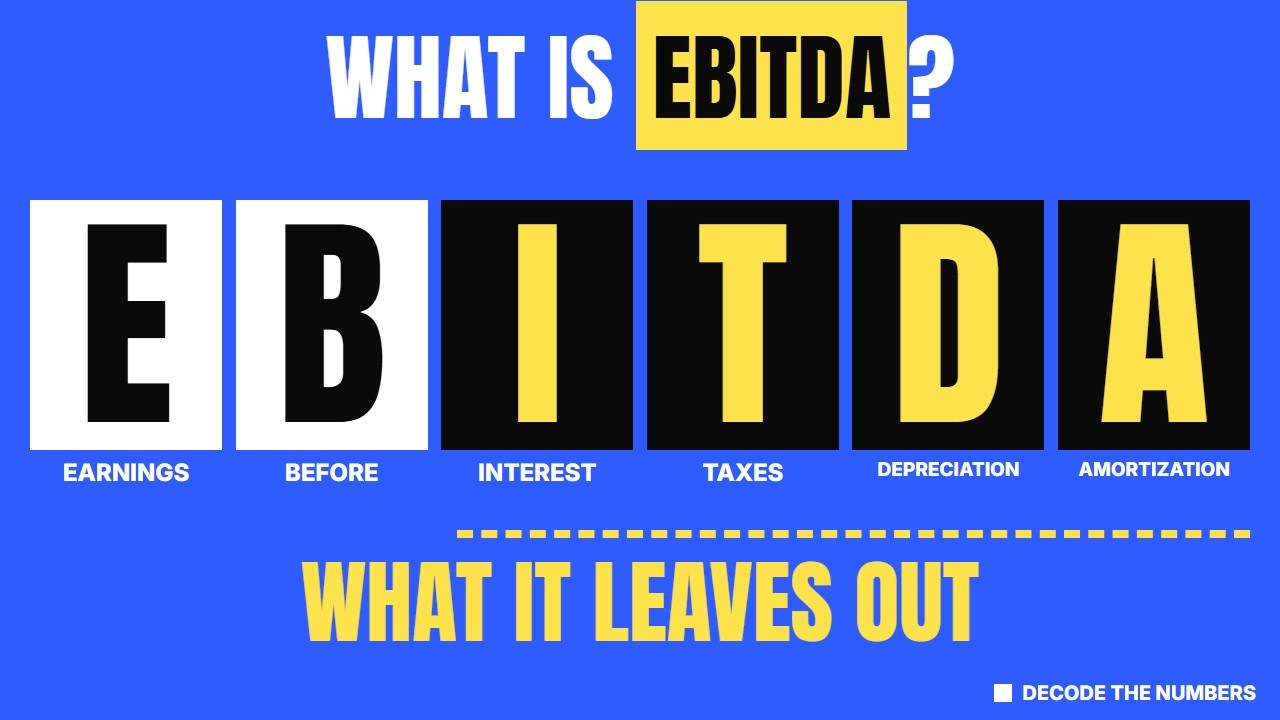
The letters stand for:
- Depreciation spreads the cost of physical assets (trucks, machines, buildings, computers) over their useful lives.
- Amortization does the same for finite-lived intangible assets, such as software, patents, licenses and customer relationships bought in an acquisition. Under US GAAP, goodwill and intangible assets with an indefinite useful life (some acquired brands, for example) are not amortized at all; they are tested for impairment instead.
- EBITA keeps depreciation as a cost but adds amortization back. Wearing out trucks is a real, recurring cost; amortizing a customer list from a past acquisition reflects a purchase already made.
Is EBIT the same as operating income?
EBIT and operating income are usually close and often identical, but they are not the same by definition. Operating income stops at the operating line. EBIT, built the SEC way from net income, keeps everything that sits between operating income and pre-tax income except interest.
The lines between operating income and pre-tax income often include:
- gains or losses on investments the company holds;
- income from companies it owns part of (equity-method income);
- foreign exchange gains and losses, depending on how the company classifies them;
- the non-service parts of pension cost, which US GAAP requires to be shown outside income from operations (FASB ASU 2017-07).
Take a hypothetical company that reports operating income of $2,000,000. It also books a $250,000 gain on selling shares it held in another company, and pays $300,000 of interest. EBIT is pre-tax income with the interest added back:
| EBIT from operating income (hypothetical) | Amount |
|---|---|
| Operating income | $2,000,000 |
| + Gain on sale of shares | +$250,000 |
| − Interest expense | −$300,000 |
| = Pre-tax income | $1,950,000 |
| + Interest expense added back | +$300,000 |
| = EBIT | $2,250,000 |
Operating income is still $2,000,000. The gain on the shares is in EBIT but not in operating income.
Two accounting quirks complicate the comparison:
- Companies define operating income differently. US GAAP does not require an operating income subtotal at all. FASB's own wording in ASU 2017-07 refers to “a subtotal of income from operations, if one is presented.” Under IFRS, the new standard IFRS 18 requires a defined operating profit subtotal for annual periods beginning on or after January 1, 2027.
- Interest income is treated inconsistently. Some analysts add back only interest expense when building EBIT, which leaves interest income inside it. Others add back net interest. Check which one a report uses before comparing two companies.
For most operating businesses with no big investment portfolio, the difference is small. For a company with large one-off gains, investment income or pension items, EBIT and operating income can be far apart.
Operating income vs. EBITDA: is EBITDA the same as operating income?
No. EBITDA is operating income before depreciation and amortization, so it is higher than operating income by the amount of D&A. The same goes for operating profit, operating earnings and income from operations, which are other names for the same subtotal. Operating income usually appears on the income statement. EBITDA is a non-GAAP measure that companies calculate and report separately. Net operating income in real estate is a different measure again; see NOI vs. EBITDA.
How big is the difference in practice? Across 4,822 US non-financial companies in Aswath Damodaran's January 2026 dataset, the aggregate EBITDA margin is 17.4% and the operating margin is 13.1%. Operating income is about 75% of EBITDA, so roughly a quarter of EBITDA is used up by depreciation and amortization. The gap varies enormously by industry:
| Industry | EBITDA margin | Operating margin | Gap (points) |
|---|---|---|---|
| Green & Renewable Energy | 58.5% | 19.9% | 38.6 |
| Oil/Gas (Production and Exploration) | 43.2% | 25.4% | 17.8 |
| Coal & Related Energy | 13.0% | −4.0% | 17.0 |
| Telecom. Services | 34.7% | 20.5% | 14.2 |
| Power | 35.3% | 21.5% | 13.8 |
| Telecom (Wireless) | 34.6% | 21.0% | 13.6 |
| Utility (Water) | 45.7% | 33.7% | 12.0 |
| Utility (General) | 34.9% | 23.5% | 11.4 |
| Chemical (Basic) | 12.3% | 2.7% | 9.6 |
| Trucking | 15.6% | 6.9% | 8.7 |
| Computer Services | 9.0% | 7.4% | 1.6 |
| Homebuilding | 14.1% | 12.6% | 1.5 |
| Engineering/Construction | 8.0% | 6.5% | 1.5 |
| Semiconductor | 36.8% | 35.3% | 1.5 |
| Retail (Distributors) | 11.4% | 10.1% | 1.3 |
| Real Estate (Operations & Services) | 4.0% | 2.9% | 1.1 |
| Food Wholesalers | 3.7% | 2.6% | 1.1 |
| Software (Entertainment) | 34.9% | 33.8% | 1.1 |
| Retail (Automotive) | 7.2% | 6.2% | 1.0 |
| Healthcare Support Services | 3.9% | 3.0% | 0.9 |
| All US non-financial companies (4,822 firms) | 17.4% | 13.1% | 4.3 |
Source: Damodaran Online, Operating and Net Margins by Sector (US), January 2026. EBITDA margin is EBITDA/Sales; operating margin is the pre-tax unadjusted operating margin. Shows the 10 industries with the largest and the 10 with the smallest gap, among industries with at least 10 firms. Financial-sector industries are excluded because EBITDA is not meaningful for them, as are Precious Metals and Tobacco, where the dataset shows an operating margin above the EBITDA margin. The gap is the displayed EBITDA margin minus the displayed operating margin, a rough guide to D&A as a share of revenue. Firm counts for each industry are in the source dataset.
The pattern is what you would expect. Renewable energy, oil and gas producers, coal, telecom, power and utilities own expensive plants, wells and networks, and a large slice of their EBITDA goes to depreciation and depletion. Distributors, wholesalers, homebuilders and many service businesses own relatively little equipment, so their operating income and EBITDA are almost the same number.
Same EBITDA, different businesses: trucking vs. software
Two companies with identical EBITDA can be very different businesses, and EBIT shows the difference. Here is a trucking company and a software company, each with $5,000,000 of EBITDA.

| One year (hypothetical) | Trucking company | Software company |
|---|---|---|
| Revenue | $32,000,000 | $14,000,000 |
| Operating costs before D&A (drivers, fuel, staff, rent, hosting) | −$27,000,000 | −$9,000,000 |
| EBITDA | $5,000,000 | $5,000,000 |
| Depreciation (trucks, trailers, laptops) | −$2,800,000 | −$200,000 |
| EBITA | $2,200,000 | $4,800,000 |
| Amortization of acquired intangibles | $0 | −$600,000 |
| EBIT (operating income) | $2,200,000 | $4,200,000 |
| Capital expenditures (cash) | −$3,000,000 | −$250,000 |
| EBITDA minus CapEx | $2,000,000 | $4,750,000 |
| EBITDA margin | 15.6% | 35.7% |
| EBIT margin | 6.9% | 30.0% |
| EBIT as a share of EBITDA | 44% | 84% |
The companies and numbers are hypothetical, invented for teaching. The trucking company's EBIT-to-EBITDA ratio was set close to the trucking industry's, where a 6.9% operating margin on a 15.6% EBITDA margin works out to about 44%.
On EBITDA, the two look equal. On EBIT, the software company earns almost twice as much ($4,200,000 against $2,200,000). The reason is the trucks. The trucking company's $2,800,000 of depreciation is the accounting cost of a fleet that wears out and has to be replaced. Its capital expenditures of $3,000,000 a year show that the cost is real cash, not a bookkeeping entry. After paying for new trucks, it keeps $2,000,000 of its EBITDA; the software company keeps $4,750,000.
The software company shows a third point. Its EBIT is reduced by $600,000 of amortization on intangibles from a past acquisition. That is why its EBITA ($4,800,000) is a better guide to its ongoing earnings than EBIT, while for the trucking company EBITA and EBIT are the same.
This matters for valuation. Because so much less of the trucking company's EBITDA survives as EBIT, a trucking company that looks cheap on EBITDA can be expensive on EBIT. The industry multiples in the next section show the same pattern. For how much companies spend on new equipment, see what capital expenditures are and how they relate to depreciation.
When analysts prefer EBIT, EBITA or EBITDA
Analysts prefer EBIT when assets wear out and must be replaced, EBITDA when they want to compare companies with different debt and accounting choices, and EBITA when acquisitions distort amortization.
EBIT: capital-intensive businesses and valuation that respects CapEx
Depreciation is the closest thing on the income statement to the long-run cost of replacing equipment. For airlines, trucking, telecom, manufacturing and utilities, ignoring it flatters the business. EV/EBIT is also the more conservative valuation multiple because it charges the company for using up its assets. Damodaran's January 2026 data shows how much the choice changes the picture:
| Industry | EV/EBITDA | EV/EBIT |
|---|---|---|
| Trucking | 10.4x | 23.8x |
| Air Transport | 7.6x | 19.3x |
| Telecom. Services | 6.5x | 12.2x |
| Software (System & Application) | 24.5x | 32.4x |
| Semiconductor | 34.8x | 44.3x |
| All US non-financial companies (4,822 firms) | 17.0x | 25.7x |
Source: Damodaran Online, Enterprise Value Multiples by Sector (US), January 2026, firms with positive EBITDA only. Firm counts for each industry are in the source dataset.
On EBITDA, trucking companies trade at 10.4x and system and application software companies at 24.5x. On EBIT, the multiples are 23.8x and 32.4x. Much of trucking's apparent discount disappears once depreciation is counted. More on this in how the EV/EBITDA multiple works.
EBITDA: comparing capital structures and leveraged lending
EBITDA ignores how a company is financed, where it pays tax and how it depreciates its assets. That makes it useful for comparing companies across countries, debt levels and accounting policies, and for a quick read of how much cash the operations generate before reinvestment. It is also the standard yardstick in lending. The 2013 interagency guidance on leveraged lending from US bank regulators, for example, used Total Debt ÷ EBITDA above 4.0x as one sign of a leveraged loan. (The OCC and FDIC withdrew that guidance in December 2025, but lenders still commonly measure leverage as debt ÷ EBITDA.) See debt-to-EBITDA for how the ratio is used.
EBITA: companies that grow by acquisition
When one company buys another, it records intangible assets such as customer relationships, brands and technology, and amortizes them over several years. A serial acquirer can therefore show low EBIT while the underlying business is healthy. EBITA removes that acquisition-driven amortization but still charges the business for its equipment. Only finite-lived intangibles are amortized: goodwill is not amortized by US public companies, while private companies may elect to amortize it over 10 years or less under a FASB accounting alternative (ASU 2014-02). That choice alone can make two otherwise identical companies report different EBIT, and EBITA cancels it out.
Software that a company builds for its own use is a special case. When development costs are capitalized, they are later amortized rather than expensed, so they never reduce EBITDA. FASB noted in ASU 2025-06 that practice is mixed on whether companies classify that amortization as depreciation or as amortization, which means two software companies' EBITA figures may not treat it the same way. Check the notes before comparing them.
What Warren Buffett said about EBITDA
Warren Buffett has been openly hostile to EBITDA because it leaves out depreciation, which he regards as a real cost. In his 2000 letter to Berkshire Hathaway shareholders, he wrote:
“References to EBITDA make us shudder.”
Warren Buffett, Berkshire Hathaway 2000 shareholder letter
In the same sentence he asked whether management thinks the tooth fairy pays for capital expenditures. In the 2002 letter he went further, calling the practice of trumpeting EBITDA “pernicious” and explaining that depreciation is an especially unattractive expense because the cash is paid up front, before the asset has delivered any benefit. His point lines up with the trucking example: EBITDA treats the cost of the fleet as if it did not exist.
Where EBIT, EBITDA and operating income appear in financial statements
Operating income is usually a line on the income statement, EBIT is rarely labeled as such, and EBITDA almost never appears on the income statement of a US public company. You usually have to build EBITDA yourself.
- Operating income (or “income from operations”) is shown on many income statements, although US GAAP does not require it.
- EBIT is rarely a labeled line. You calculate it as pre-tax income plus interest expense.
- EBITDA appears in earnings releases, investor presentations and the management discussion section of annual reports, as a non-GAAP measure with a reconciliation to net income. SEC staff guidance (Staff Accounting Bulletin Topic 11.B) says depreciation should not be positioned in the income statement so that it produces a figure for income before depreciation, which is why EBITDA is not a line item there.
- Depreciation and amortization are often not shown on their own income statement line, because part of them is buried in cost of sales and operating expenses. The reliable place to find them is the cash flow statement, near the top, where D&A is added back to net income.
For a full walk from revenue down to net income, with every subtotal and margin, see EBITDA vs. net income, gross profit and revenue. To compare EBITDA across companies of different sizes, divide it by revenue to get the EBITDA margin.
FAQ
Is EBIT or EBITDA higher?
EBITDA is higher, or equal when a company has no depreciation or amortization. EBITDA equals EBIT plus depreciation and amortization, and those two charges are never negative.
How do you get from EBIT to EBITDA?
Add depreciation and amortization to EBIT. You find both on the cash flow statement, where they are added back to net income near the top.
Is operating profit the same as EBITDA?
No. Operating profit is after depreciation and amortization, while EBITDA is before them. EBITDA equals operating profit plus D&A, assuming there are no non-operating items in between.
Is net operating income the same as EBITDA?
No. Net operating income (NOI) is a real estate measure of property revenue minus property operating expenses, usually before corporate overhead. The full comparison is on the NOI vs. EBITDA page.
What does EBITA stand for?
EBITA stands for earnings before interest, taxes and amortization. It subtracts depreciation of physical assets but adds back amortization of intangible assets.
Should I use EV/EBIT or EV/EBITDA?
EV/EBIT is the stricter test for capital-intensive companies because it counts depreciation as a cost. EV/EBITDA is more common and works better when comparing companies with different depreciation policies or tax positions.
Is EBITDA a GAAP measure?
No. EBITDA and EBIT are non-GAAP measures. When a US public company reports them, SEC rules require a reconciliation to the most directly comparable GAAP measure, which for EBITDA is normally net income.
Can EBIT be negative while EBITDA is positive?
Yes. If depreciation and amortization are larger than EBITDA, EBIT is negative. This is common in young, capital-heavy businesses and in companies carrying large acquisition amortization.
Related

Sources
- SEC, Non-GAAP Financial Measures interpretations, formerly C&DIs (Question 103.01)
- SEC, Staff Accounting Bulletin Topic 11.B, Depreciation and depletion excluded from cost of sales
- FASB, ASU 2017-07, Compensation: Retirement Benefits (Topic 715)
- FASB, ASU 2014-02, Intangibles: Goodwill and Other (Topic 350), private company alternative
- IFRS Foundation, New IFRS Accounting Standard will aid investor analysis (IFRS 18), April 2024
- Federal Reserve, Interagency Guidance on Leveraged Lending (SR 13-3), 2013
- OCC, OCC and FDIC rescind leveraged lending guidance, December 2025
- Berkshire Hathaway, 2000 letter to shareholders
- Berkshire Hathaway, 2002 letter to shareholders
- FASB, Statement No. 142, Goodwill and Other Intangible Assets (paragraphs 16 and 18)
- FASB, ASU 2025-06, Intangibles: Internal-Use Software (Subtopic 350-40)
- Damodaran Online (NYU Stern), Operating and Net Margins by Sector (US), January 2026
- Damodaran Online (NYU Stern), Enterprise Value Multiples by Sector (US), January 2026